Both double front doors and one oversized entry door can create a generous entrance, but they are strongest in different use patterns. Double front doors work well when a project wants a comfortable daily active leaf and extra width only when both leaves are opened for furniture, deliveries, or larger gatherings. One oversized entry door is often more convenient when the broad passage is part of everyday circulation, such as in homes where strollers or mobility devices regularly pass through the entry. The decision is therefore less about which option can create a wide opening and more about whether the extra width is needed every day or only occasionally.
After that use pattern is clear, compare facade proportion, swing space, hardware load, threshold exposure, and the clear passage available in normal operation. Both layouts can satisfy a project when they are sized and supported correctly; they simply distribute the opening, hardware, and weather seals differently. For custom entrance doors, these conditions provide a clearer basis for choosing one leaf or two than appearance alone.
|
Decision factor |
Double front doors |
One oversized entry door |
|
Daily use |
One primary leaf handles routine access; the second stays secured. |
One broad leaf provides the routine clear passage. |
|
Occasional wide access |
Both leaves can open for furniture, deliveries, service equipment, or larger gatherings. |
Available width stays within the single leaf clear passage. |
|
Hardware load |
Shared by two smaller leaves. |
Concentrated on one larger leaf. |
|
Center joint |
Meeting stile and inactive-leaf hardware. |
No center meeting joint. |
|
Swing space |
Two smaller arcs. |
One larger arc. |
|
Facade effect |
Supports symmetry. |
Cleaner uninterrupted face. |
|
Weather detailing |
Extra center seal line. |
Broad-leaf alignment is more critical. |
Daily Use Favors a Clear Primary Door
Double front doors are commonly arranged with one active leaf for everyday use while the companion leaf stays secured. That arrangement works well when the primary leaf already provides a comfortable routine passage and the second leaf is only needed from time to time. The active leaf should therefore be sized for normal arrivals on its own, with a simple latch sequence that does not require users to release both leaves for ordinary entry.
One oversized entry door handles daily circulation differently. Its full clear passage is available through one operating leaf, which can be useful where a wider routine path is important, including homes where strollers or mobility devices regularly move through the entrance. The tradeoff is a larger swing radius and a heavier leaf, so the foyer or porch, hinge or pivot system, closer, stop, and frame support all need to suit the actual door size and weight.
Occasional bulky access is a separate question. Moving furniture, receiving large deliveries, bringing service equipment through the entry, or opening the house for larger gatherings can make a double configuration more useful because the inactive leaf can be released to create a wider temporary passage. A single oversized door can still handle many of these situations when its clear width is sufficient, but that width cannot expand for special events. Separating everyday circulation from occasional full-width access makes the comparison more convincing than asking one door layout to solve both scenarios in the same way.
Leaf Size Changes the Hardware Conversation
Large entrance doors place more demand on hardware as leaf width, height, weight, material, and expected use increase. A tall oversized leaf places a larger turning load at the hinge or pivot because the forces act farther from the support. That does not rule out a single leaf, but it makes door construction, frame attachment, swing control, and threshold alignment more consequential. Heavy entry doors also need a realistic plan for adjustment after the building settles and finishes are complete.
A double door divides the opening into two smaller leaves, which can reduce the demand on each support point. It also introduces a center meeting condition. Astragals, flush bolts, multi-point locks, and weather seals at the meeting stile need to work together without making the active leaf awkward to operate. The lock and handle should be selected as part of that arrangement, not added after the leaf geometry is fixed.
A pivot can support a large, visually simple slab and can make a wide door feel controlled in use. It needs floor and head conditions that are prepared for the pivot hardware. Conventional hinges place the load at the jamb and can suit many traditional or transitional entry compositions. Neither option is merely a style choice. The selected support method must be compatible with the finished floor, framing, weather exposure, and available swing clearance.
Facade Proportion Should Survive the Close View
A double entry can give a broad facade a clear centerline. It may align well with a transom, paired columns, or symmetrical sidelites. The visual benefit can disappear if the leaves become too narrow for the overall opening or if the center seam competes with nearby grille lines and joints. A full-scale elevation, or even a taped layout on site, can reveal whether the meeting stile lands in a calm place within the composition.
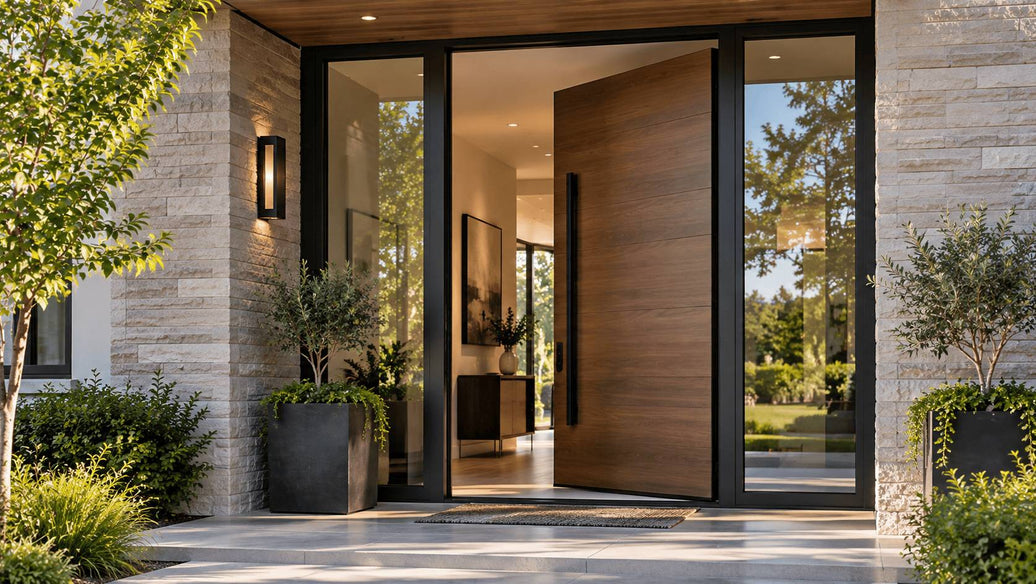
For a modern house front door, one oversized entry door can create a single uninterrupted field rather than a pair. That can suit a facade with long horizontal lines, minimal trim, or an off-center entrance. It also brings the handle, lock, panel joints, and any glass cutout into sharper focus because there is no second leaf to balance the view. The surface design needs to read well from the street and at arm's length.
Threshold Exposure Is Different at the Center Seam

Every exterior entrance needs a water-management approach suited to its exposure and wall construction. With double front doors, the center meeting point creates another vertical joint, while the sill must work across both leaves. A deep porch may reduce exposure. On an open elevation, the sweep, sill, drainage plane, and head protection need closer coordination.
A single oversized door eliminates the center seam but increases the importance of a straight, stable frame. A small twist at the jamb or threshold can show up as uneven reveals around a broad leaf. The entry slab, sill support, and adjacent cladding should be coordinated so water is directed outward and the door can be adjusted without disturbing the surrounding finish.
Once the opening, swing zone, facade proportions, and threshold exposure are defined, Luvindow can review custom entrance doors as paired or single-leaf configurations against the project conditions.
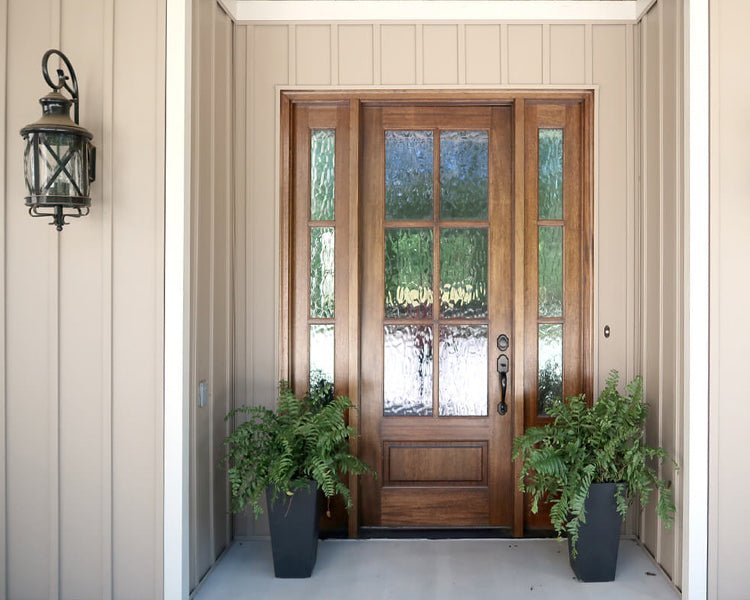
The double-panel wooden entry door provides a relevant paired-door reference when the project calls for a symmetrical entrance and occasional full-width access.
For oversized single-leaf layouts, a pivot-door configuration can be evaluated within the broader entry door collection when the floor, head, leaf weight, and swing conditions support it.
Choose the Layout That Fits the Entrance Routine
Door thickness and construction also influence the choice. A wide glazed leaf, a solid insulated leaf, and a timber-faced assembly place different demands on support hardware. Decorative grooves, moldings, and glass cutouts can change stiffness, so the final leaf construction may require a different support method or a revised division of the opening.
Match Swing Direction to the Entry Approach
The entrance approach changes the daily experience. An outward-swinging entry door needs enough exterior landing and approach space for users to remain clear of the moving leaf. An inward-swinging leaf needs foyer clearance that is not occupied by a console, stair, or closet door. With a double entry, the inactive leaf needs a secure and reachable way to release it when the full opening is required. Draw those movements with real furniture and circulation, not with an empty floor plan.
How Sidelites and Transoms Change the Entry Layout
Glazed sidelites and transoms can increase the apparent scale of an entrance without increasing the width of the operating leaf. For a project already leaning toward one oversized entry door, they can preserve a broad facade composition while keeping the moving leaf within a more manageable size. They do not replace the double-versus-single decision; they simply change how much of the overall opening needs to move. On a facade with strong vertical proportions, sidelites or a transom may reinforce the composition, while a minimalist facade may still favor one uninterrupted leaf when the support and swing conditions allow it.
Finally, distinguish clear passage from nominal door size. Handles, stops, frame geometry, leaf thickness, and opening angle all affect the usable route. When comparing double front doors with a large single door, check that clear path early so the choice reflects daily use as well as facade appearance.
Which Is Better: Double Front Doors or One Oversized Entry Door?
Neither option is universally better, and both can work well when the opening, hardware, and threshold are designed for the selected configuration. Double front doors make the stronger case when the entrance needs a comfortable primary leaf for daily use plus occasional extra width for furniture, deliveries, service access, or larger gatherings. One oversized entry door makes more sense when the wider passage is part of the everyday routine and the project favors a single uninterrupted door face. If both options provide the required clear passage, the final decision should come down to use frequency, swing clearance, leaf weight, hardware support, facade proportion, and weather exposure.
Before the entry is released, confirm the finished opening dimensions, floor build-up, swing zone, hand of operation, hardware support, clear passage, and threshold exposure. Then confirm whether the project needs extra width every day or only on specific occasions. That final distinction keeps the choice tied to actual use rather than appearance alone.
For a project-specific entry layout, share the facade and opening information with the Luvindow team before finalizing the leaf arrangement and hardware approach.
FAQ
Q: Are double front doors less secure than one large door?
A: Security depends on the complete assembly, including frame anchorage, locking, glass where used, hardware, and installation. The number of leaves alone does not determine the outcome.
Q: Does one oversized entry door always need a pivot?
A: No. The support method depends on the door size, construction, weight, swing, and framing. A pivot is one possible solution, but it requires compatible floor and head conditions.
Q: Can a double entry have one active leaf?
A: Yes. Many paired entrances are arranged for one leaf to serve daily use while the second leaf opens when the full width is needed.